

For millions of individuals recovering from surgery, living with chronic weakness, or managing age-related decline, the simple act of standing up from a chair or bed can become a monumental challenge. Caregivers often bear the physical brunt of these transfers, risking their own health through repetitive heavy lifting. Traditional manual sit-to-stand lifts offer some relief, but they still demand significant effort from both the patient and the assistant. Enter the power sit to stand lift — a game-changing piece of equipment that combines electric motorization with ergonomic design to automate the upward motion. Unlike manual models that require the caregiver to crank or pump a hydraulic lever, a powered lift uses a rechargeable battery or plug-in motor to smoothly raise the patient from a seated to a standing position. This innovation does more than reduce physical strain; it restores dignity, promotes active patient participation, and redefines what safe, efficient mobility assistance looks like in home care, skilled nursing facilities, and hospitals.
The mechanics of a power sit to stand lift are both simple and sophisticated. A sturdy base frame rolls underneath a bed, chair, or wheelchair. A sling or vest is placed around the patient’s torso and under the arms, then attached to the lift’s crossbar. With the press of a button, an electric actuator lifts the crossbar, gently pulling the patient forward and upward into a standing posture. The patient’s feet remain planted on the floor or on a footplate, encouraging weight-bearing through the legs. This partial weight-bearing is crucial — it helps maintain bone density, joint mobility, and muscle tone over time. Meanwhile, the caregiver’s role shifts from lifter to guide, simply stabilizing the patient or positioning a walker. The result is a transfer that feels natural, controlled, and far less intimidating for all involved.
Choosing a power sit to stand lift over a manual alternative also addresses hidden costs. Caregiver back injuries are a leading cause of lost workdays in healthcare, and manual lifts, though safer than unaided lifts, still expose the caregiver to twisting and lifting forces. Powered models virtually eliminate these forces by replacing human muscle with electric power. In addition, many units feature programmable tilt angles, speed adjustments, and emergency stop functions that provide precision and safety unmatched by manual systems. For patients, the psychological benefit is equally real: knowing that they can stand without fear of falling — and without relying on someone else’s strength — fosters confidence and encourages more active engagement in rehabilitation. Whether in a post-surgical recovery plan or a long-term care setting, the power sit to stand lift represents a tangible step forward in assistive technology.
The Biomechanical Advantage: Why Powered Assistance Outperforms Manual Lifts
To fully appreciate what a power sit to stand lift brings to a care plan, one must understand the biomechanics of the sit-to-stand movement itself. Rising from a seated position requires coordinated activation of the quadriceps, glutes, core stabilizers, and even the upper body for balance. For a patient with post-operative weakness, neurological conditions like Parkinson’s disease, or general deconditioning, generating enough force from those muscle groups is often impossible. Manual sit-to-stand lifts provide a leverage advantage, but they still require the caregiver to apply continuous, sustained force — typically through a handle or pump — to raise the patient. This force transmission is uneven and can cause the patient to lurch or tilt, increasing the risk of slips or shoulder strain. A powered lift, by contrast, delivers a smooth, constant velocity throughout the entire arc of motion. The electric actuator provides a consistent torque that compensates for patient weakness or sudden movements, reducing jerking and allowing the body to align naturally.
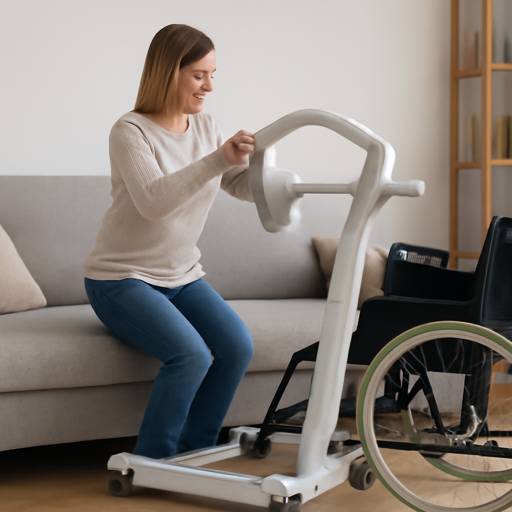
Furthermore, the power sit to stand lift enhances postural control. Many powered models incorporate a knee pad that braces the patient’s knees during the lift, preventing forward collapse while maintaining a natural hip and knee angle. This knee support is adjustable to accommodate different leg lengths and chair heights. The footplate provides a stable, nonslip surface, and the sling design often includes a padded back support that prevents the patient from sliding backward. Caregivers can also control the lift’s speed — slow and steady for a nervous patient, faster for someone who needs quick repositioning. This level of customization is absent in manual systems, where the caregiver’s own strength and stamina dictate the pace. Research from the American Journal of Nursing and other rehabilitation sources consistently shows that powered sit-to-stand devices reduce caregiver strain by up to 70% compared to manual lifts, while also improving patient satisfaction scores in clinical trials.
Another often-overlooked advantage is the integration of battery management systems. Modern power lifts are designed for portability: they can be wheeled from room to room, charged overnight, and used for multiple transfers in a single shift. Some units even feature low-battery alarms and backup emergency lowering capabilities. This eliminates the need for staff to constantly check hydraulic fluid levels or recalibrate manual mechanisms. In a busy facility, where nurses and nursing aides may perform dozens of lifts per day, the reliability of a power system directly impacts workflow efficiency. Fewer mechanical failures mean fewer delays, less waiting for patient transfers, and a lower overall risk of injury to both patient and caregiver. The biomechanical superiority of powered lifts is not just a matter of convenience — it is a fundamental upgrade in the safety and effectiveness of patient handling.
Real-World Applications and Case Studies: From Home Care to Acute Rehab
To illustrate the impact of a power sit to stand lift, consider the case of a 72-year-old woman named Margaret recovering from a hip replacement. Initially, she required two caregivers to help her stand from a chair — one on each side, supporting her arms and torso. At home, her husband, who had his own back issues, struggled to assist. After their physical therapist recommended a powered sit-to-stand lift, the dynamics changed entirely. Margaret could now stand independently using the lift’s controls, with only minimal supervision. Her husband simply positioned the walker in front of her. Within two weeks, Margaret’s quadriceps strength improved enough to reduce her reliance on the lift for short transfers. The case shows how a power sit to stand lift is not merely a crutch but a training tool: it allows partial weight-bearing at a controlled pace, building muscle without fear of falling. This is a classic example of the device being used for both acute recovery and long-term rehabilitation.
In a skilled nursing facility setting, another application stands out. A 64-year-old male patient with multiple sclerosis had lost the ability to stand independently due to progressive weakness. Manual transfers required two staff members and a full-body sling, which was time-consuming and often left the patient feeling passive and helpless. The facility introduced two power sit to stand lifts on the rehabilitation unit and trained staff on their use. Within a month, the patient was able to stand with the lift’s assistance for up to five minutes, performing standing exercises that improved his bladder function and circulation. The occupational therapist noted that the patient’s mood and motivation improved dramatically because he regained a sense of agency — he could initiate the lift by pressing a button rather than waiting for staff. This is a recurring theme in case reports: powered lifts encourage active patient engagement, which is a key predictor of positive rehabilitation outcomes.
A third example comes from a home health agency serving a pediatric patient with cerebral palsy. The standard approach had been a manual lift, but the child’s growth made transfers increasingly difficult for the mother. The agency loaned a pediatric-sized power sit to stand lift. The child, though non-verbal, clearly showed less resistance and anxiety during transfers. The mother reported feeling less physical strain and more confident that she could continue caring for her child at home rather than seeking residential placement. These real-world scenarios underscore that the benefits of a power sit to stand lift extend far beyond the clinical metrics. They touch on quality of life, caregiver sustainability, and the emotional well-being of everyone involved. Whether the setting is a private residence or a bustling hospital ward, the technology offers a scalable solution that respects the patient’s dignity while protecting the caregiver’s health. As the aging population grows and the demand for home-based care increases, case studies like these will become increasingly relevant to policy makers, therapists, and families making equipment decisions.

